




Uncover the real impact of minimum credit card payments.
Paying off debt is a journey of small, intentional steps and a key part of managing it is understanding your monthly statement. The "minimum payment due" line item might seem like a low-cost way to stay on track, but it can sometimes be a roadblock to your long-term financial freedom.
In this article, we will take a look at what happens when you make a minimum payment, the hidden costs they carry, and the powerful strategies you can use to move beyond them. Together, we can turn your goal of paying off debt into meaningful achievements.
What is a minimum payment?
A minimum payment is the smallest amount of money your credit card issuer requires you to pay each billing cycle to keep your account in good standing. Paying it on time helps you avoid late fees and protects your credit history from negative marks for missed payments.
Typically, it’s a small percentage of your total outstanding balance, often around 1% to 3%, or a flat fee (like $25), whichever is greater. While it may seem like a low-cost way to meet your immediate obligation, it’s important to view it as the floor, not the ceiling, of what you should pay.
The illusion of affordability
A minimum payment can certainly feel like a lifeline, especially during months when your budget is tight. Making that small payment can provide a temporary sense of relief.
This short-term solution, however, can mask a much larger problem. Because the amount is so small, it creates an illusion that your debt is more manageable than it actually is. This leads to a cycle where you continue to spend, believing you can easily handle the balance later, all without realizing how quickly your balance is getting out of control.
The hidden cost of paying the minimum
While convenient, paying the minimum comes with significant long-term costs that can slow down your goal of paying off debt. Understanding these hidden costs is the first step toward taking control.
Accumulation of interest
When you only pay the minimum, the vast majority of it goes toward interest charges, not your principal balance. Because you're making very little progress on the principal, interest continues to accrue month after month. This process is called compounding interest, and it's what makes paying off debt so difficult when you only pay the minimum.
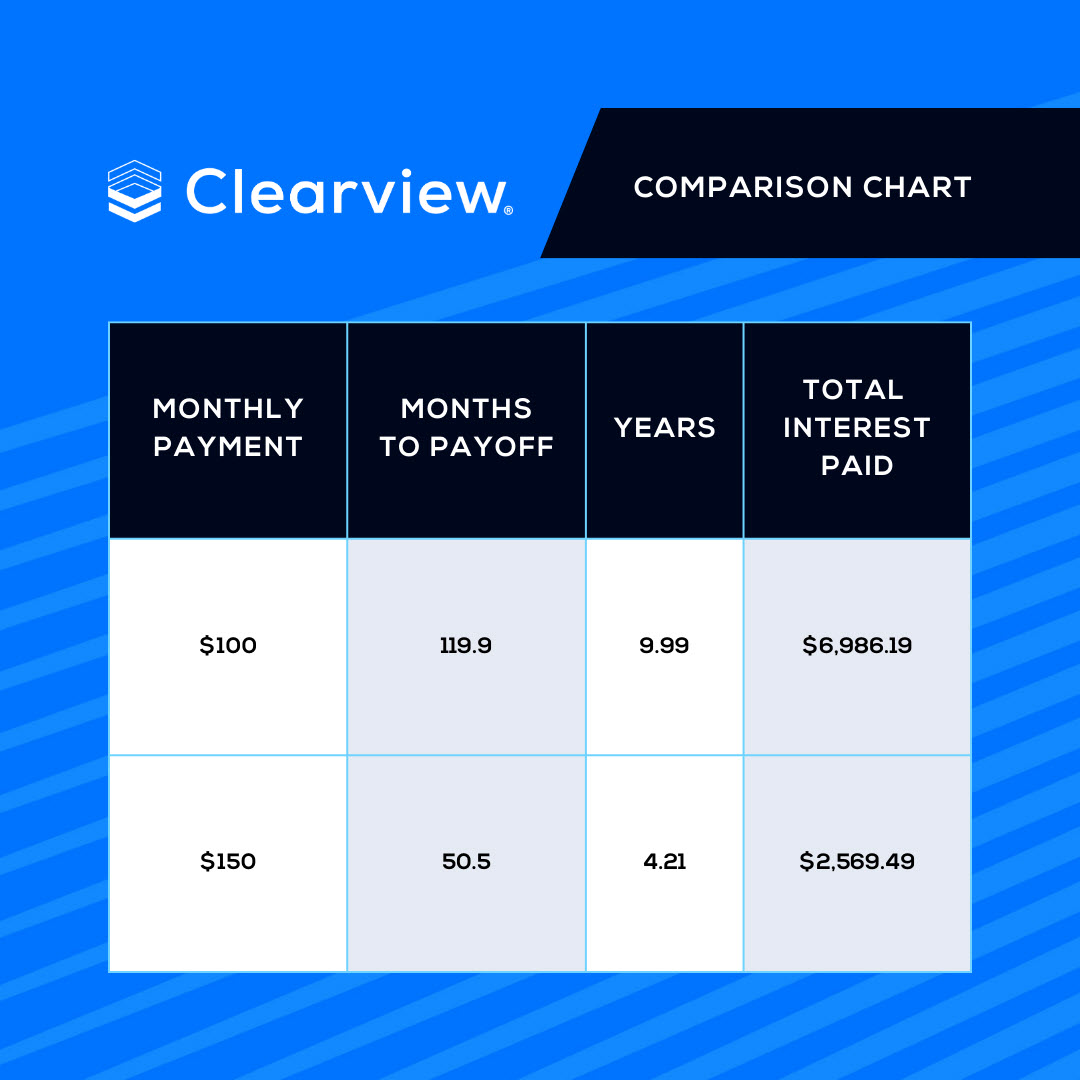
For example, imagine a $5,000 credit card balance with a 21% annual percentage rate (APR). A 2% minimum payment would be $100 and of that $100, $87.50 will go to interest, leaving only $12.50 to go to the principal. Take a look at the chart below to see how a minimum of $100 versus $150 impacts the accumulation of interest paid!
The cycle of debt
This slow progress can easily lead to a cycle of debt. As your balance remains high, new purchases and compounding interest keep adding to it. You get stuck running in place, making payments every month without seeing your balance decrease meaningfully. This can be incredibly discouraging and make financial freedom feel out of reach.
Impact on your credit score
Another hidden cost relates to your credit utilization ratio. This is the amount of credit you're using compared to your total available credit limit. For example, if you have a $2,000 balance on a card with a $5,000 limit, your utilization ratio is 40%.
Lenders prefer to see a low credit utilization ratio, generally below 30%. Carrying a high balance by only paying the minimum keeps your ratio elevated, which can negatively impact your credit score. Plus, having a lower score can make it harder to get approved for future loans or secure favorable interest rates.
Tips to avoid the minimum payment trap
The good news is that you can take clear, confident steps on your journey of paying off debt. We’re here to support you with strategies that work!
1. Pay more than the minimum
The simplest and most effective strategy is to pay more than the minimum amount due whenever you can. Even an extra $25 or $50 each month can make a significant difference. This additional amount goes directly toward your principal balance, reducing the amount of interest you'll be charged in the following months, and shortening your repayment timeline.
2. Create a supportive budget
Creating a budget provides a powerful framework for empowerment. It gives you a clear picture of where your money is going and helps you identify areas where you can allocate more funds toward your goals, like paying off debt. Might we suggest giving our free budgeting tool, Money Management, a try?
3. Choose a debt repayment strategy
Having a structured plan can provide the motivation you need to stay on course. Two popular methods are the debt snowball and the debt avalanche. Both strategies are effective at paying off debt, but the best one for you is the one you feel confident you can stick with.
4. Consider consolidation options
If you have multiple high-interest debts, consolidation might be a helpful option. This involves combining several debts into a single new loan, ideally with a lower interest rate. Here are two common options to consider:
- Balance transfer: Many credit cards offer a 0% introductory APR on balance transfers. This allows you to move your high-interest balance to a new card and pay it down for a set period (often 12-21 months) without accruing new interest.
- Debt consolidation loan: A personal loan can be used to pay off all your credit cards at once. You’re then left with one fixed monthly payment, often at a lower interest rate than your credit cards.
Your financial freedom is worth it!
We believe in your ability to take control of your finances and build a prosperous future. By understanding the true cost of minimum payments and using these strategies, you are not just paying off a balance; you are building a foundation for a life of greater opportunity. When you succeed, we all succeed!
-
Minimum payments are typically calculated as a small percentage of your balance (e.g., 1-3%) or a fixed dollar amount, whichever is higher, plus any accrued interest and fees. -
Paying only the minimum extends the time it takes to pay off your debt and significantly increases the total interest paid, keeping you in debt longer. -
Paying the minimum on time won’t hurt your credit score, but it may limit your ability to lower your credit utilization, which can impact your score. -
The total interest depends on your balance, APR, and payment amount, but with minimum payments, you could end up paying more in interest than the original balance.